We close today at 4:00 and reopen Tuesday, December 1 at 7:30 for a normal day. Hope the break is peaceful and the holiday joyous.
Friday, November 20, 2009


Thursday, November 19, 2009
The Future of Our Books
Since Cushing Academy, a New England Independent School, made the decision to ban books in paper format from its library, there’s been a lot of discussion about the “future of the book.” Boston University recently held a conference with that title. Members of the Cooperative Library Association reported on the conference at a meeting that I recently attended. They reported that not all presenters were as certain as Cushing’s headmaster that the future of the world would be a future without paper books. Christopher Ricks, Warren Professor of the Humanities at Boston University, stated that information, data, knowledge, and culture are not interchangeable terms and that reading while being bombarded with electronic messages from your computer screen is “like exercising on a treadmill while you munch on a bag of chips.”
Here at the Governor’s Academy we have no desire to rid our shelves of books. Students who wish to read online can find plenty to read. We purchase access to databases containing thousands of magazine, journal, and newspaper articles. However, when our students need reliable information and archived writings of the history of knowledge, we will continue to provide them with distraction free, wireless connection to paper content in our 28,000 volume library.

Here at the Governor’s Academy we have no desire to rid our shelves of books. Students who wish to read online can find plenty to read. We purchase access to databases containing thousands of magazine, journal, and newspaper articles. However, when our students need reliable information and archived writings of the history of knowledge, we will continue to provide them with distraction free, wireless connection to paper content in our 28,000 volume library.
Wednesday, November 18, 2009
Biology on Display

Tuesday, November 17, 2009
Apples and Oranges May Compare After All
The word orange can't have anything in common with the Spanish naranja (for 'orange'), can it? The words look and sound so different. Actually, they share a historical connection.
As a word, orange came to the English language in the 15th century ultimately from Persian through French and Italian. The Persian original, nāranj or nārang, shows the connection between the English and Spanish words. The connotation between the fruit and the color orange was also formed centuries ago, in Middle French, and the form of the word changed under the influence of the word or ('gold'; in Latin aurum). This fascinating tidbit was brought to you by An Etymological Dictionary of the English Language, shelved at REF 422 SKE.
There are other European languages where the word for oranges is a compound formed basically of references to apples and China. For example, in German the word is die Apfelsine and in Danish appelsin.
If you know to look for it, all these words preserve a minute detail of the history of citrus fruit in Europe and the trade routes to the Far East.
Monday, November 16, 2009
Freshman IFA fall projects - Ceramics
Currently on display are tiles made by freshmen in Ms. Irina Okula's Introduction to Fine Arts class. These tiles were each made individually and then combined and mounted onto a display board. After forming the tiles the students had to polish them smooth. Each student was required to create a recognizable animal, flower or person on one tile. The shapes and lines were created by wrapping or forming copper wire against the tile while it was being fired in the kiln.
All these tiles were fired in a “saggar” pot. The tiles were put in the pot with sawdust soaked in cobalt, yellow ochre, or just left plain, along with a bowl of salt, and then fired in a gas kiln at 1,700 degrees.

All these tiles were fired in a “saggar” pot. The tiles were put in the pot with sawdust soaked in cobalt, yellow ochre, or just left plain, along with a bowl of salt, and then fired in a gas kiln at 1,700 degrees.
Friday, November 13, 2009
Try Knitting for the Winter Season
The fall season is coming to an end and students are being asked to select an activity for the winter season. One choice is Knit Club, open to both the novice and the expert knitter. Instruction and guidance is supplied by Chris Robinson. Students knit warm scarfs, hats and mittens which are donated to the Pettengill House in Salisbury. As stated on their website: "Pettengill House strongly supports education, health and self determination. Our programs continue to have built in self sufficiency mandates which foster independence, dignity, self advocacy and responsibility."
Knit Club is a great place to learn new skills and help keep people warm! Talk to Mrs. Robinson in the bookstore and then come check out one of our knitting books for patterns and inspiration.

Knit Club is a great place to learn new skills and help keep people warm! Talk to Mrs. Robinson in the bookstore and then come check out one of our knitting books for patterns and inspiration.
Thursday, November 12, 2009
America Recycles Day, November 15
America Recycles Day is a nationwide initiative promoted by Keep America Beautiful, Inc. (KAP) and the National Recycling Coalition (NRC).
The purpose of America Recycles Day is to continue to promote the social, environmental and economic benefits of recycling and encourage more people to join the movement toward creating a better natural environment. It is the only nationally recognized day dedicated to encouraging Americans to recycle and to buy recycled products. 2009 marks the 12th ARD.
The Governor's Academy has had its own green program for a number of years now. Our library has recycling bins for paper, bottles, and cans, both for patrons and staff. We encourage you to use them - we do!
Wednesday, November 11, 2009
Special Olympics Soccer Volunteers
Every year the Governor's community looks forward to combining our motto "Not for self, but for others" with a fun filled day of soccer and hundreds of very special athletes. On Sunday students, faculty, and staff from Governor's Academy and Triton Regional High School hosted the annual Massachusetts Special Olympics Soccer Tournament Finals. The skies were sunny, the athletes were ecstatic, and the smiles were evident all around.

Tuesday, November 10, 2009
Learning to Learn - But How?
Here at the Pesky Library we attempt to support all learners and learning styles. The reading/writing-preference learners are easiest to accommodate simply because of how libraries as an institution developed. Modern libraries, however, contain much, much more than just printed word.
For auditory learners, we have language aids, for example, as both tapes and CD-ROMs. We carry both fiction and non-fiction audiobooks (shelved at AC, near the entertainment DVD collection). For visual learners, we not only have films and documentaries, but also visual dictionaries of English (REF 423) and teach yourself books loaded with diagrams. Check out the various crafts books, for instance. You can also browse our movie versions of classic works of literature - but be aware, they often take surprising liberties with the story compared with their written 'ancestors!' Tactile learners are, perhaps, the most challenging to serve, but we do try. All through the academic year, we set up displays that include reading materials for browsing, captions and explanations, and accessories.
If you have an idea of how we could help you learn better or better take your learning style into account, please let us know!
Monday, November 09, 2009
Berlin, 20 Years Ago
Today we celebrate the 20th anniversary of the fall of the Berlin Wall. The event led Germany to reunify, plus caused the collapse of the Soviet Union and the Cold War's end.
Today, Berlin residents and visitors alike gathered at the Brandenburg Gate to remember how the Germans rejected the dividing lines represented by the wall. German Chancellor Angela Merkel - who grew up in East Germany - presided over the celebrations, which were attended by tens of thousands of people despite a downpour of rain. After the leaders spoke, a chain of 1,000 giant foam dominoes, painted with messages of freedom by young people, was toppled along where the wall once stood. The festivities were capped with fireworks and a concert featuring music from Berlin's State Opera and the American rock band Bon Jovi.
Pop into the library for more information, and don't forget to check out the Berlin Wall display in the lobby.
Thursday, November 05, 2009
Steaming the Display
Our community service volunteers are helping us prepare our November displays. They are steaming the wrinkles from the bunting which will be used as a backdrop for "Letters to and from the homefront." We have really enjoyed having these two be part of our library program during the afternoons this fall.

Wednesday, November 04, 2009
NaNoWriMo
November is the National Novel Writing Month, a fun, seat-of-your-pants approach to novel writing. Participants begin writing November 1. The goal is to write a 175-page (50,000-word) novel by midnight, November 30.
Part of the reason behind NaNoWriMo is just to get a book written. It's all about quantity, not quality. The kamikaze approach forces you to lower your expectations, take risks, and write on the fly.
The way to win NaNoWriMo is by writing 50,000 words by midnight on November 30. Every year, there are many, many winners. You must be 13 or older to have an account on NaNoWriMo.org. But all ages are very welcome to take part in National Novel Writing Month. It is an international event despite the "National" in the title - it does not refer only to the United States. This is an event for all nations. You can write novels in any language you like.
Check out our library display for inspiration, or go to nanowrimo.org for more information.
Tuesday, November 03, 2009
H1N1 at TGA
Yesterday The Governor’s Academy vaccinated 100 high risk students and faculty against H1N1.
The H1N1 flu, also known as "swine flu," is a respiratory disease caused by a type of flu virus. The Massachusetts Department of Public Health has collected a number of resources to help you better understand the disease. They include audio files, podcasts, and tips on how to protect yourself from catching the H1N1 virus.
For the most up to date information on the spread of H1N1 flu and state programs in Massachusetts, please visit the DPH blog. The updates include downloadable weekly PDF reports.
Naturally, the school Health Services can also help with questions. The Duncan Health Center is open 24 hours a day, seven days a week. You can contact them at (978) 499-3126.
Please remember that most cases of the H1N1 influenza have been mild. Most people have not required hospitalization and have recovered uneventfully.
Although there is an increase in the number of influenza cases on campus, all classes and activities are proceeding as planned at the moment.
Monday, November 02, 2009
Lost and Found
The first quarter is barely finished, and already there is a surprising number of books, notebooks, and umbrellas in the Lost and Found bin in the copier room. There is also a tall stack of clothing, including jackets. Please go check the bin and retrieve yours!
Friday, October 30, 2009
Scary Movies
If you're thinking about cuddling up to a nice scary movie tonight, check out our DVD display. We have 1,000 entertainment videos in our collection and at least one of them is sure to make you look under the bed or into dark corners. Happy Halloween!

Thursday, October 29, 2009
Students today interact with information in entirely different ways than their teachers ever did. While we adapt to use digital information, we also wonder if students have lost some of the ability to process information in their quest to be online, all the time.
This morning I took advantage of new digital capabilities to view and listen to the keynote speech from the Internet Librarian conference while sitting behind the library desk. Vint Cerf, VP & Chief Internet Evangelist for Google, spoke about how people interface with information. He shared that in a recent conversation, Henry Kissinger expressed concern that people are thinking more shallowly about things than they once did; that such communications as emails, Facebook, and Twitter reduce the amount of time we spend thinking about things. Mr. Cerf re-stated this by saying that our culture is trending toward abstraction and brevity. He said that “Power corrupts and PowerPoint corrupts absolutely.”
In education, we love to adopt new technologies and expose our students to as many time-saving gizmos and gadgets as we can. The important thing to remember is that the technology is not the important part. If the technology makes the education more accessible, then we should use it. However, technology for the sake of technology may breed students who no longer have the critical thinking skills to solve the problems of today and tomorrow.
Wednesday, October 28, 2009
New Databases on Trial
We're currently evaluating new databases to see if they provide material for your research needs. This is a great opportunity to find more resources for your papers for free!
To access the trial databases, go to http://elmstreet.govsacademy.org/course/view.php?id=517 or Elmstreet > Database Trials (underneath Library). The databases require a user name and password; these are listed in the Elmstreet document.
Tuesday, October 27, 2009
Jack-o'-Turnip?
Halloween (or All Hallows’ Eve, or All Saints’ Eve) is associated with symbols like the jack-o'-lantern. But did you know that these lanterns were first carved from a turnip or a rutabaga?
A 1970's collection of Scottish Halloween traditions describes the carving of a turnip lantern like this:
"To make a lantern, choose a large round turnip. From the top, cut off a thick slice--about a quarter of the whole--and scoop out the inside, preferably with a spoon, taking care not to break the skin.
The 'shell' should be as this as possible, but a stump must be left at the bottom and hollowed out to serve as a socket. Now take a sharp pen-knife and carve on the turnip a man-in-the-moon face, a skull and cross-bones, or other device. Then get a candle, plain or coloured as desired, and set firmly in the socket. Make two holes near the top, one at each side of the handle. It should be long enough to prevent any risk of burning one's hand. Alternatively, the lantern may be suspended from a forked stick.
When the lantern is lit, there is a soft, luminous glow, and the device you have carved stands out clearly. There is room here for considerable artistry."
The excerpt above - and many other intriguing traditions - can be found in The Folklore of World Holidays (REF 398.2 MAC).
Monday, October 26, 2009
Things to Read
 Looking for something else to read besides text books? Our profile on LibraryThing links to book reviews written by current and former students, staff, and faculty of the Governor's Academy. On Being Foreign: Culture Shock in Short Fiction is an interesting read found through the reviews that I happen to have personal experience with. I probably would not have found it on the shelves had it not been for serendipity - and LibraryThing!
For a little more playful approach, check out what The Book Seer recommends. This web site suggests titles on the basis of books you like. These suggestions are pulled from two popular web sites (LibraryThing and an online store).
Friday, October 23, 2009
Dummer Doodles
This week, our archivist Laurie DiModica has been busy with the inventory of antique books housed in The Governor’s Academy Archives. She made a singular discovery and shared the following with us:
“There are approximately 300 books, with the oldest dating to the 17th century. Many of the books—their handcrafted bindings and leather covers worn but resilient—can be traced to their use during the earliest years of the academy, when Headmaster Samuel Moody educated hundreds of boys during his 27-year tenure (1763-1790). So many of these boys went on to lead notable lives in government, military, business, and the ministry. It is possible to identify several of the antique books as belongings of specific students; inscribed with the handwritten “Dummer’s School,” the oldest of the books also list their owner’s name and date of ownership. Some of the books were handed down from student to student, traceable through chronological order.
While the signatures begin to personalize these items, a few books reveal a bit more. In R. Brookes’ The General Gazetteer: Or, Compendius Geographical Dictionary, a 1762 publication that was shared by William Williams of Salem and Samuel Moody of Newbury (students of the academy ca. 1783-1785,) one can see, tucked on the inside front cover and initial page, an example of 18th century student doodling.

In the photograph below, doodles from the inside cover of The General Gazetteer can be seen, including an outline of two male figures, one much more detailed than the other, and labeled with “John Stoddard”. The page is ripped just next to this text, but it is likely that it read “Wanton” to reflect the name of another Dummer School student, John Wanton Stoddard of Newport, RI. Stoddard attended the academy during Headmaster Samuel Moody’s tenure. Is the Stoddard’s drawing of himself…or perhaps this is a caricature from a friend (Williams? Moody?).
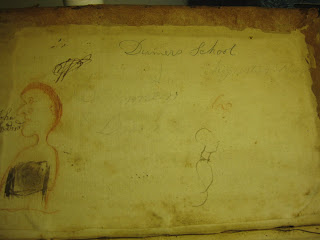
Apparently, the contents of The General Gazetteer—descriptions of “all the empires, kingdoms, states, republics, provinces, cities, chief towns, forts, fortresses, castles, citadels, seas, harbours, bays, rivers, lakes, mountains, capes, and promontories in the known world; together with the government, policy, customs, manners, and religion of the inhabitants—was not enough to keep Dummer boys singularly focused!”
Thanks, Laurie for reminding us that students haven’t really changed over the centuries!
Subscribe to:
Posts (Atom)